Thursday, August 19, 2010

Post-Nuptial Depression - And How I Coined This Term


Who would have thought? I originally published this piece in Salon back in 1999, before the term "Post-Nuptial Depression" was commonplace. Turns out I was the one who coined the term! How's that for a claim to fame? :)
==============================================================
Postnuptial Depression


It's summer again, which means wedding season, which means thousands of clenched-teeth brides-to-be across the country are pacing their offices, living rooms or kitchens with a cordless in one hand and a bridal checklist in the other: Trial run wearing dress, shoes and lingerie? Check. Make sure extra bobby pins are in delicate seed-pearl evening bag? Check. Gifts for bridal party? Check, check, check. It's a niggardly, ruthless list and it's way too long, I know, but I have one more thing to add: Prepare for post-nuptial depression.

Maybe it was just me, but for about two weeks following my own wedding last June, I couldn't get out of bed. I felt overwhelmed, agitated and drugged. I could accomplish nothing but sleep. Granted my apartment is conducive to sleeping, what with its crib-like proportions, its lack of windows and the constant presence of a warm and cuddly dog, but this wasn't your regular sleep. This was an every-time-I-open-my-eyes-I-can't-face-reality-so-I-go-back-to-sleep sleep. And according to the Eli-Lily advertisements, this meant I was depressed.

But what on earth was I depressed about? I adored my new husband (still do), I was happy about our marriage and excited to embark on this new life. What was the deal?

Before I attempt to answer this question, I'd like to say I've always had a pretty casual (read: phobic) attitude toward marriage. I never pushed any of my boyfriends for proposals or diamond rings, never gave them ultimatums or moved out if I didn't "see marriage in the future." When I finally did get married, I was (still am) in my 30s, and had already turned down two previous proposals. I guess I've always looked at marriage as an event in my life, not the event.

But once you start to plan a wedding it slowly begins to assert itself as The Event and you have no choice but to bow down to it and pray.

After the engagement, not one day went by when I didn't imagine myself floating down the aisle in the Dress of my Dreams. But then I'd realize I didn't know what the Dress of my Dreams was, so I'd make notes to visit Wearkstatt and Vera Wang, Bloomie's and Bendels, all the thrift shops, Milan, and then I'd realize I didn't know what kind of aisle I wanted, or if I wanted an aisle, or even a church, with all its heady religious implications. So perhaps a Nantucket beachfront would do, if I only knew someone who had one ... but wouldn't all that sand ruin my satin shoes?

Knowing that I can be kind of a borderline obsessive-compulsive person, and because our budget was tight, my fianci and I decided to keep the wedding as simple as possible. There would be no band, no limo, none of that bouquet-and-garter stuff. There would be no video recording equipment and we wouldn't take our honeymoon until the fall. There would be no three-story cake because I knew if we had a cake I'd have to see and smell and taste every single wedding cake in the country before narrowing it down to maybe 10 and then I'd spend hours, days and weeks agonizing over which one to pick. Then, my fianci would say, "Just decide already," and we'd get into an argument and finally, just to settle the matter, I'd have to select any old $900 cake which, at the reception, would be gone, eaten by a pack of 4-year-olds, in about 60 seconds. No, there would definitely be no cake.

And you know what? The simplicity really paid off. We had a manageable number of guests (50 people), a manageable setting (a New England farmhouse) and unpretentious food. Because we had no fanfare, my husband and I could act more like guests at the reception, not vaudevillians. And, best of all, everyone seemed to have a good time, including me.

I was told by millions of girlfriends that I would not remember the day itself, but I remember every second of it. I remember waking up to sunlight and a beautiful blue sky (something blue!) and realizing I'd forgotten to even obsess about the weather. I remember spending the whole gorgeous morning getting ready with my sisters and nieces, applying eye shadows and lipsticks, pinning flowers into hair. I remember laughing as we tried to fit me and my dress into the back seat of my brother-in-law's old Taurus and checking my mascara in my compact mirror about 800 times as we drove to the church. I remember said mascara running down my face the minute I made eye contact with my father, who was waiting proudly at the entrance for me to take his arm. I remember the sharp, sweet scent of my bouquet as we "proceeded" up the aisle, and knowing that the bouquet in my hands was shaking, but not wanting to look down, and looking instead at the faces of aunts and the uncles, the grandmothers and girlfriends, and finally, him, all smiling at me, some with tears. I remember the profound beauty of the ceremony, most of which we had written, and the almost palpable vibe in the room as we repeated our vows. It was the energy of 50 happy people in sync with one another, all of us believing at that moment in the power of love.

So why, after all this perfection, did I spend so many days afterward feeling so depressed? Why did I feel like I had failed somehow? What was suddenly so alluring about my bed? I decided to poll some of my newlywed friends to see how they'd survived their weddings. "I remember waking up the next day and saying, 'That's it?'" my friend Anne said. She designs missiles for the government. "Twelve months of planning and now this, just your basic hangover?"

My younger friend Mary, a Harvard entomologist, had this to say: "It's like when, you know, you kill an ant while it's eating something and its jaws remain clamped on the food. That's how I felt after my wedding. Like my jaws were still clamped onto something." She rubbed her chin. "I had to go down to Chinatown and get herbs."

Melinda, an aspiring actress, said her reaction was identical to how she felt after the closing night's performance of a play, or at the end of a movie shoot. "After spending six months becoming a character, it's not like you can just abandon that person overnight. You need some time to adjust."

Hmmm. So, like, a bride is a character and putting together a wedding is like producing a film? I tested this analogy on my new husband, a producer himself.

"Um," he said, perplexed. "I think you were just tired. That was a lot of work."

My sister said, "Stop trying to analyze so much."

Would that I could. It's an extraordinary event, a wedding. And after it was over I got to thinking that my own life, in comparison, was, well, ordinary. The curtains had closed, the makeup artists and hair stylists had moved on to real clients and I was no longer a bride. I began to suspect that my wedding really was the most elaborate gala I'd ever attend. Never again would I be the center of attention like that. Never again would I be told how beautiful I look for six straight hours. Never again would I get to spend so much time conspiring with my stepmother, an extraordinarily busy woman I adore. Never again will I be allowed to throw away ungodly sums of money on a dress, a headpiece, a makeover. In other words, never again would I get to live a day in the life of Gwyneth Paltrow.

I've heard it said -- mostly by men -- that it's more stressful to be engaged than to be married. It's as though they are saying that it's more challenging to head toward an unknown than to be in the midst of it. And normally I would agree with this as I, too, stress out much more during the journey. But why the exception in this situation? Why did I not show any signs of stress until after I'd said my vows?

I'm thinking it was because of the planning. Planning, in some perverse way, must have helped to alleviate some of my stress. Granted, the planning produced small anxieties of its own, but nothing I couldn't handle. That bridal checklist, asinine as it was, provided a series of tasks I had to accomplish -- tasks that were logical and sequenced. As I moved through the list, it gave me a sense of accomplishment and forward motion that I guess my fianci didn't feel. Those not involved in concrete issues like what hors d'oeuvres to serve have more time to dwell on the abstracts. My soon-to-be husband, for example, walked around for months holding his head and saying, "My God! What have I done?" while I concentrated on Martha Stewart Living, which told me I must wrap fresh moss around my centerpieces to give them a rustic look.

It wasn't until after the dress had been put away, the moss donated to the compost and our bank accounts dredged that the searing reality of what I'd just done really hit me: I'd gotten ma-ma-married. I would remain married for the rest of my life. I think it was the enormity of this concept that kept me in bed.

"You could have avoided all of this post-nuptial depression stuff if you'd done one thing," my friend Judith, the med student, said over the telephone. I expected her to recommend a chemical cure like Zoloft or Xanax.

"You should have taken a honeymoon right away," she said.

Ah, yes, the honeymoon. I thought of all those advertisements in the backs of the bridal magazines showing vibrant, energetic, and incredibly evenly-tanned couples riding horseback or frolicking in the sea. The looks on their faces always suggest a smoldering passion, as if they'd just left the heart-shaped bedroom or are on their way back. Too bad there were always about 800 of these ads beckoning you to choose among 800 luscious destinations.

"I just figured having to plan a honeymoon on top of everything else would have added to the stress," I said.

"You could have used a travel agent," said Judith. "Don't you live in New York? Don't you people pay other people to stress out for you?"

"Well yes, but ... " I started to think of my friends' photo albums and realized their honeymoon pictures were nothing like the honeymoons of advertisements. No, they seemed to have spent most of their days passed out on beach towels. "Don't you just end up taking your post-nuptial depression with you to some place expensive?"

"Some place tropical," Judith said. "And of course you take it with you, but if you drink lots of piqa coladas, you won't notice it as much."

Let it be known: The doctor has spoken.

Friday, August 13, 2010

Should Dogs Attend Catholic Funeral Masses? Mine did....


I’ve been to many a dog-funeral (including a Buddhist sukhavati for my own beloved dog Wallace...and I do plan to write about this someday, when I have the time), but never before have I brought my own dog to a funeral. Not until this week, that is.

It wasn’t like Chloe (the dog) was invited. Nor had a planned to bring her, but circumstances were such that I had to rush back to Massachusetts to make it to the service on time, and I had to bring Chloe, because I did not have time to find a sitter. I thought I would be able to leave her in the car during the service, or at least tie her up outside the church, with a dish of water, a marrow bone, and a copy of Cat Fancy magazine. But the church had no trees. And it was ninety degrees in the shade.

So I really had no choice, right? I must confess I was nervous about this decision. A) the funeral service had already begun by the time I arrived, which meant I risked walking in the wrong door, and finding myself at the front of the church instead of the back, thereby revealing to all the mourners my possible lapse in tact, propriety, and judgment. Churches are always confusing like that—especially old New England churches, which seem to have dozens of entrances and no signs.
So that was risk A.

Risk B was that the funeral was being held at a Catholic church, and if I recall correctly Catholics don’t believe that animals have souls, right? So would they allow a being without a soul into their chapels? Would they allow me, a Buddhist who sings Hindu and Sikh chants, and practices Native American ceremonies, and believes in One God/dess Many Paths? And who believes that not only do dogs have souls, but that some of them are more advanced than we humans? (I was raised Catholic, by the way, which by Law allows me to poke fun at this institution)


Well, there was only one way to find out. I put Chloe on a close “heel” and entered through the hallowed doors. If lightning stuck, I’d know dogs weren’t allowed at St. Joseph’s.

If lightning did not strike, and no clouds parted (revealing a hand pointing its finger of judgment at me a la Michelangelo), well, groovy.

Chloe is an exceptionally well-trained, well-behaved dog, by the way—I knew that would work in our favor. Plus, the woman whose funeral mass we were celebrating was a life-long dog lover. As was her husband, who had passed seven months prior.

We entered. And found ourselves at the back of the church. Excellent. No one noticed our entrance; the second reading had already begun and people were lost in their own thoughts—of Jane and all the goodness and kindness she had spread through the world.
I thought how Chloe was a good and kind being too. I thought of my best high school friend, sitting way up front, mourning the sudden loss of her mother. And of her father. And of her beloved, beloved dog Lydia, who had died in April. My friend had endured a lot of loss in the past seven months. And yet she sat up there with her shoulders straight and her spine erect and poised. She has always been a graceful woman. So was her mother. I said my silent goodbyes to Jane and Bill, and said a few prayers for my friend. I even said a few prayers for my long-departed dog Wallace, and asked him to keep an eye out for Lydia, who still might not be used to life beyond the beyond.
As I had this thought, my dog Chloe wagged her tail.
And the lightning did not strike.
This is when I finally cried—and how good and sweet life can be, and yet so sad at the same time. I guess you can’t have one without the other. Until you leave this world. Death didn’t seem so bad. Neither did life. Not with a dog by your side.

Anyway, I am starting to go off on mystical tangents when I am supposed to be writing about my dog.

After the service ended, we all stood, and the family filed out of the church, preceded by the priests. The first one swung an urn of incense back and forth, filling the aisles with the scent of frankincense. The second one walked piously, with his hands folded around his Bible. This second priest made a point to make eye contact with all the mourners and because I was at the very back of the church I knew I would be one of the last. My dog stood at my side, partially hidden from view. I worried again what the priest would think—if I had committed some grave cardinal sin. (I would have known this, perhaps, if I had paid attention in Sunday School, but who does that?)

I backed up a bit, as if to shield the dog from view. But then she sneezed. Incense does that to her. The second priest looked over, to find the source of the ground-level sneeze, and thereby saw my dog. She wagged her tail at him and moved forward to say hello. He smiled in a kind and loving way.

All God’s creatures, I thought.

My friend’s entire family smiled too as they passed. And I like to think that my dog brought them some sort of comfort on this day of mourning. That the dog reminded them of their own family dogs, of the dogs their parents had raised and loved. Of love itself. For that is what dogs are: love. On four legs.

So in the end, no one complained about the presence of my large furry spaniel. She was even welcomed to come to the post-funeral reception. There, the young grandchildren clambered about her, bringing her water and pieces of fried chicken, rubbing her belly, laughing at the way she squirmed and smiled when she wagged her tail.

It was heartwarming, to say the least. Especially when my friend’s 6-year old daughter, Clara, said to my friend: “Mommy, Grandma is with Grandpa in heaven now, right?”

My friend answered yes.

“And Lydia is there, too?”

“Yes, Lydia is there, too.”

“Good,” Clara said.

And it was good. She ran up to my dog and gave her a hug.

Wednesday, June 30, 2010

Sound Healing for Dogs


This is a cross-post from my blog on thebark.com
http://www.thebark.com/content/soothing-songs-anxious-pup

Soothing Songs for the Anxious Pup
How sound healing can help calm your dog


For the past few years, I’ve been moonlighting as a sound healer and also a kirtan walla. (Kirtan is a lively form of call-and-response chanting that originated in India thousands of years ago). Because this is a dog-related blog, I won’t go into too much detail about the human benefits of sacred sound and sound healing; suffice to say your dog can benefit too.

Back in 1998, before I had even begun to study sacred sound, I happen to notice that certain music had an unusually calming effect on my dog Wallace. (Wallace is my former beloved Spaniel, known to many Bark readers as the star of Rex and the City.)

There we were, the dog and I, sitting in our cramped Lower East Side apartment on a swelteringly hot summer night, wishing we were on another planet--one with air conditioning and more reasonable rents--and listening, as a consolation prize, to “New Sounds,” excellent hour-long music program on WNYC radio.

New Sounds is one of those programs that really can transport you to another planet, because the host, John Schaefer, always manages to find such spectacularly, ethereal music--the kind that transcends time, space, and the mundane.
Anyway,the feature CD of that evening was Canticles of Ecstasy by Hildegard Von Bingen, sung by the vocal ensemble Sequentia. Hildegard was a twelfth-century German mystic who began receiving ecstatic visions at age three and was sent to a convent at age eight. There, she began composing angelic canticles, said to have been channeled directly from the Divine.


I noticed Hildegard’s magic immediately--not only in the way it seemed to pulse through my body with a pure white light, but in the way my dog reacted. He was a Setter as well as a Spaniel mix, which basically meant that he never stayed still--not even in sleep. He was constantly pacing, sniffing, snuffling, hunting, flushing, pointing, galloping, grunting or, at the very least, panting--in a way that could get annoying in a hot NYC apartment. In his sleep he would woof, flex his paws, twitch his nostrils, and sometimes even groan in frustration--at not ever being able to catch that rabbit, perhaps.

But once Hildegard started playing, Wallace actually lay down--he rarely did that. Then he placed his head between his paws and let out a huge, pre-nap sigh. He stretched, one leg at a time, and positioned his body in perfect repose.

He knew I was watching him. I often stared at him, because he was so beautiful, and because I didn't have much else to do in those days of stunted writing.
And I could tell he was trying to keep his eyes open in that way dogs do, when they want to take a nap but also want to make sure they don’t miss out on anything exciting I might do at any second.
But by Sequentia's third canticle his eyes had lolled back into his head and he was out.

An ecstatic trance, perhaps? Would he re-emerge from this slumber speaking in tongues? Or at least in Latin?

Meanwhile, Sequentia sang Spiritus Sanctus Vivificans Vite, the high soprano notes of ecstasy soaring up to the ceiling.

My dog slept an entire hour. His breathing was so deep and slow I could barely see his rib cage moving. He didn’t once twitch or woof. And his muscles were completely relaxed.

By the time the program was over, I knew I was on to something. I called my then-husband immediately and suggested he pick up a copy of the CD on his way home from work.

Our lives changed after that. We had more freedom to actually leave the apartment once in a while, without having to worry about our overly-anxious dog. Our neighbors got so used to the sound of Quia Ergo Femina Mortem Instruxit drifting sweetly into the hallways that they began to get worried if it wasn’t playing.

Wallace’s entire temperament seemed to change--slowly but surely--in the same way my temperament would change, years later, when I myself starting singing and composing my own ecstatic chants.

Funny where life leads us.

Funny that sometimes we don’t even realize we’re being led.

We’re too busy trying to find new ways to improve the lives of our dogs.

And in the process, we improve ours. Because somehow, in some convoluted way, the fact that I was able to observe the effects of sound healing on my dog led me, many years later, to practice on myself.

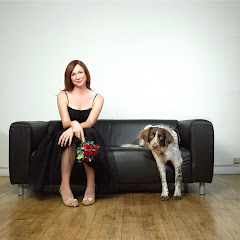
But getting back to dogs: In 2004, after Wallace had passed and my marriage had disintegrated, I found myself adopting a new dog, Chloe. She's that Spaniel pictured above, with one of her one-night stands. (We can't even remember that Boxer's name, but boy was he fun!)
ANyway, Chloe had extreme separation anxiety when I first adopted her. In fact, she’d already had five homes in the first six months of her life, because her anxiety was so bad. Inexperienced dog owners simply couldn’t handle her whining, barking, drooling, chewing, escaping, etc... But I knew I could handle her. Because I had experience. And marrow bones. And Hildegard.
I played the Canticles of Ecstasy for Chloe around the clock. And within two weeks her separation anxiety had completely vanished.

Fast-forward to the present, and here I am with the Calmest Dog on the Planet. Pretty impressive for a Border Collie mix, I’d say. People always ask me: How do you do it? And I give three answers: clicker training, holistic nutrition and sound healing.

I’d say, on average, I play sacred music about eight hours each day. I believe this music purifies the space, and creates healing vibrations that re-align both me and my dog on a daily basis.

Sound is vibration, and our physical bodies respond to vibration--whether you believe it or not. Fast-paced, frenetic noise will increase our heartbeats and make us feel, well, frenetic. Erratic music will make us feel erratic. But soft, slow, rhythmic music will calm us. Drums beat at certain cycles can lower the blood pressure and induce theta states of mind. You might be saying, “Well, duh, this isn’t rocket science,” but actually it is.

Science has now proven that certain sounds have healing effects on certain parts of the body. The yogis and sages have known this for millennia, of course, but it takes these Western doctors a while to catch up with things. Now these Western doctors are witnessing cancerous tumors going into remission from treatments with Tibetan Singing Bowls, and bi-polar patients reaching a point of equilibrium by listening to a sacred gong.

So why couldn’t a dog with separation anxiety benefit from soothing music?

Why not give it a try? It’s easy and your dog benefits greatly. I swear even my house plants look healthier from the nonstop sacred music.

My recommended picks of soothing songs for doggy snoozing are:

Canticles of Ecstasy by Sequentia
Gong and Singing Bowl Meditation by Scott Kennedy
Ultimate Om by Jonathan Goldman
Lalitha Ashtrotram by Craig Pruess
Atlantean Crystal Temple by Steve Halpern

My dog would second these opinions, but she’s currently asleep.

Saturday, June 26, 2010

When a Man Pretends to Like Dogs to Get Into Your Pants


This essay appeared in the Bark magazine in March 2009. Now that enough time has passed, I can admit that the Friend I referred to was my own self.

----------------------------------------------------------------------------------
Blind Date Faux Paw
Rule #1: You can’t fake dog love.
Lee Harrington | 31 Mar 2009
Does he or doesn't he really love dogs?

This story comes from a friend who wishes to remain anonymous on the off chance her former blind date reads this. (We are hoping enough time has passed that said Blind Date will no longer be Googling my friend). They didn’t hit it off, you see, because Blind Date committed the unpardonable act of pretending to be a dog person. He knew my friend loved dogs, and he knew my friend was attractive, and single, so he lied—-all in the name of trying to get into her pants.

We are not impressed.

The setting of the story: a holiday party, last December. My friend loves holiday parties, so she readily accepted an invitation from a man she barely knew. She had just moved to a certain rural town near a certain hip city, and had not, to date, made any new friends. She thought this party would be a grand and fun entry into her new life. Plus, the man claimed that he loved dogs.

The evening included bluegrass Christmas music, nutmeggy eggnog spiced with cognac, and cool hippy-types who wore their grey hair long. But let us fast-forward to the moment when Date invited Friend to sit next to him on a sofa near the fire. He patted a cushion, which prompted the host’s dog—a shaggy, little Wheaton-mix—to run over and leap onto the vacant spot.

Friend said: “How cute!”
Date? He pushed the dog to the floor.
Roughly.

As you can imagine, Friend made a decision right then and there never to see Date again. He tried to snuggle with her on the couch, but Friend snuggled with the dog instead. Date repositioned his body on the sofa so that his legs and arms touched Friend’s, but she kept moving further and further away, to the point where she was almost sitting on some fiddle player’s lap.

It was a long night for Friend. She’s typically not a grudge-holder, except when someone roughs up a puppy.

On the drive home, Date—perhaps sensing Friend’s disappointment—tried to regale her with what he thought were amusing dog stories: the time he tried to put his own dog to sleep and it took three days for the poison to kick in; the time a farmer shot his daughter’s dog and how he and the farmer ended up becoming good friends. Perhaps it’s a cultural thing, but my friend found none of this funny.

(Date concluded the evening by telling Friend she had no sense of humor and that she needed to ‘loosen up,’ but that she was still a hot babe and he’d be interested in sleeping with her.

I love the ‘but’ part. As if being hot somehow made up for all her perceived character flaws.)

Anyway, quite a few novels and movies have been written about such scenarios—about men who pretend to be dog people just to get into a woman’s pants. But in those fictional accounts, the men usually end up falling in love with the dogs and everyone lives happily ever after. In this case, a true fraud was exposed. But my friend was at least grateful her date had exposed his true self before the relationship progressed any further. Dog love is not something you can fake. So fellas, don’t even try.

Print|Email
Share:

* Delicious
* Digg
* StumbleUpon
* Reddit
* Facebook
* Google
* Yahoo

Lee Harrington is the author of the best-selling memoir Rex and the City: A Memoir of a Woman, a Man, and a Dysfunctional Dog (Villard, 2006). Her novel, Nothing Keeps a Frenchman From His Lunch, is forthcoming from Random House in 2010. She is working on both the second volume of her Rex and the City memoir and a screenplay version of the first volume. Lastly, she is the lead singer of an all-female Who tribute band, Pictures of Lily, and, late at night she blogs about dogs at www.emharrington.com.

Friday, June 25, 2010

How to Get Your Dog Approved by those dreaded New York City Coop Boards


Rex in the City XXIV: Board Approved

Originally appearing in Issue #41, Mar/Apr 2007

It’s always stressful to throw your first adult party, and it can be even more stressful if you have a really hyper, poorly trained (or rather, imperfectly trained) dog. It was the year 2000 and Ted and I had just moved to a 350-square-foot apartment in Brooklyn. This was a big step up for us, given that our previous apartment was only 300 square feet. You might be shocked at that number, but we were overjoyed to have a bedroom door that could actually close (or slam, as the case may be) because there were no bureaus or beds blocking the way. It was indeed cause to celebrate.

So we decided to throw a housewarming party. Now, long-time readers of this column may recall that, when we first adopted Rex, three years prior to this party, he came to us fear-aggressive, anxious and mistrustful of humans, one of whom had abused him cruelly. With lots of loving care and training, we managed to “cure” him of his aggressions, but there is one thing you can’t cure an English Setter of, and that is being an English Setter, which means exuberant and energetic— and in a 350sf apartment, “energetic” can translate into “hyper.” Plus, only one-third of our guests would qualify as “dog people”—the rest of them liked to wear black and keep their clothing fur-free.

My first thought was to send Rex off to doggie day-care for the morning. (Because we were now officially adults, we decided to throw a brunch rather than a big smoky keg party with Jell-O shots and bags of chips.)

But Ted, having been sent off to boarding school as a pre-teen, said this could cause undue psychological damage.

“How’s he going to know we didn’t invite him to our party?” I said.

“Dogs always know. Plus, he’ll smell the remnants of 80 people … and quiche.”

So the dog was invited.

Then something—an article in the New York Times, perhaps?—gave me an idea: Sedate the dog. Now, before you throw this magazine down in disgust and call me irresponsible, hear me out: people do this in New York, you see, when they need to bring their dogs before potential co-op boards for “review.” A co-op board, whose job it is to make sure that you are socially acceptable and financially secure, can reject you for any number of reasons—maybe your daughter’s tongue piercing would be more appropriate at a co-op in Tribeca than one on the Upper East Side, or maybe you are a world-famous entertainer who happened to have published nude photographs of yourself a few years back. And I’d heard more and more stories of people getting rejected because the boards didn’t approve of their dogs.

Then and now, dogs often get a bad rap in New York. Every week, it seems, the local papers publish articles on this-or-that bad dog doing such-and-such, and as a result, co-op boards have become more and more strict about what kinds of dogs they allow into their hallowed towers, or if they allow them at all. Board members worry that dogs will bark all day; pee in the elevators; jump on strangers; or, in the spring, when the rain is at its worst, shake themselves off right next to a famous socialite and ruin her $4,000 Fendi baguette handbag.

Whatever. We all know there is no such thing as a “bad dog.” Just a poorly trained or improperly treated one. But New Yorkers have learned to take extra precautions in their “dog interviews” with the co-op board. Elite groomers are paid hundreds of dollars to triple-bathe the dogs, administer hot-oil conditioners, spend an hour on the blow-outs and then spritz the dogs with special aromatherapy oils, like bergamot or lavender, which are said to lull board members into a state of complacence and well-being.

Or people will spend $1,500 for five one-hour sessions with a dog trainer who specializes in the dog interview. In these sessions, the dog learns to sit, hold a down-stay and shake hands with the president of the co-op board, all while counting out his/her guardian’s income with thumps of his/her tail (say, one thump for every hundred thousand).

Then there was the couple in Tribeca who had a rather nasty and very vocal Jack Russell Terrier who didn’t like shoes, and because most people in the lobbies of luxury co-ops wear shoes, he was constantly nipping peoples’ ankles. They knew they could not bring him to the interview because all the board members would be wearing shoes. And so, at the last minute, they traded their dog for an imposter, a look-a-like JRT from a different litter. This imposter licked the president’s face, shook her hand, then went into a down-stay and literally smiled and thumped her tail at each board member who spoke. They were unanimously approved.

What I found most shocking were the stories I heard about people sedating their dogs with Valium. I guess, if you can’t afford the $300-an-hour training fee, Valium is available for a few dollars (or nothing, if you steal them from someone else’s medicine cabinet at their first housewarming party). But still. I was horrified. I was horrified and yet a little seed had been planted in my head.

And I know it sounds awful and irresponsible to even consider sedating a dog for a party, but I was an idiot back then, and lazy, and had not yet discovered clicker-training, which works so well I probably could have clicker-trained Rex into donning a tuxedo and mixing drinks.

“You can’t give him drugs,” Ted said. “What kind of mother are you? He’s fine the way he is.”

“I know he’s fine. He’s perfect. This will make him more perfect.”

“But this isn’t a co-op interview,” Ted added. “It’s a party for our friends.”

“It’s just that not all of our friends love dogs the way we do. Besides, I’m not giving him Valium. I’ve giving him herbs.”

A friend had recommended Rescue Remedy, which she said was the vodka martini of the dog world. It wouldn’t sedate him, she said; it would just “chill him out.” They use it for dogs in shock, she said, and for those who are terrified of thunder.

Now, I’m a fan of chillin’, so I used myself as the test subject before dosing up the dog. Just a few drops in a glass of water, or straight onto the tongue, and lo, I didn’t feel drugged or sedated, just oddly blasé and unhurried. I felt I had discovered the New Age “Mother’s Little Helper.” In fact, I liked it so much I decided to give myself a triple dose for the party. (Things like hosting parties stress me out, and Martha Stewart’s magazine is to blame, because her level of perfection is one that I can never seem to meet.)

“Want some?” I said to Ted, half an hour before our guests were to arrive. I held out the little glass vial which was, I realized, the same size as a syringe. Ted shook his head. “Bad mother,” he said, in the same teasing voice he used when he said “Bad dog.” I placed four drops of the Mother’s Little Helper on top of Rex’s head.

We served what adults are supposed to serve at housewarming parties: white wine, tiny quiches, fancy sparkling waters and a gruyère fondue. And we also served up an uncannily well-behaved dog. He’d been to the groomer and smelled like lavender oil, and his fur was silky and oh-so-white. People kept commenting on how beautiful he was, and how sweet and calm. There was a $16-per-pound wedge of Spanish goat cheese on the low coffee table that he didn’t even bother to sniff, let alone scarf up. And he didn’t climb up onto the windowsill and bark at passersby on the sidewalk. He did not once try to jump on the furniture because it was more effort than he could expend. Mostly, he wanted to lie on the floor and receive his well-deserved belly-scratches. “I wish I had a dog like that,” one of Ted’s friends said, and I wanted to tell her that this wasn’t a dog like that, but I was feeling just so blissfully blasé.

Throughout the party, I’d notice Rex resting his head on the knee of my editor, or sleeping at the feet of Ted’s boss, and was pleased to see that he hadn’t slobbered on her shoes. In fact, he hadn’t slobbered on anyone, or jumped, or barked. And for the first time, I knew what it was like to have a mellow dog—to have the sort of dog a co-op board would approve.

“Didn’t people, in the olden days, used to give their children brandy to help them sleep?” I said to Ted after the party.

“Yes,” Ted said. “In their milk.”

“I am a bad mother,” I said.

“Let’s go for a walk,” Ted said. We took Rex to Prospect Park as a reward. The “remedy” had worn off at that point, and he was back to his hyper, happy, hunting-dog self. We let him off-leash and watched as he chased after squirrels, manically followed scent trails, crashed through bushes and leapt over rocks, and actually bit the base of an oak tree, seemingly determined to bring it down because there was a squirrel’s nest up there. “He certainly doesn’t seem to have a hangover,” Ted said. “Maybe I’ll try this herb myself.”

“Oh, you should,” I said, perhaps a little too quickly (because what wife doesn’t want to sedate her husband once in a while?).

Ted just raised an eyebrow and called for the dog. He came bounding back to us, covered with burrs and mud and panting with bliss. So much for the $70 trip to the groomer and the aromatherapy oil. He seemed positively delighted with himself and his condition. And we were delighted, too. “Perfect dogs probably get really boring,” I said to Ted.

“Perfect people, too.”

Years later, one of our guests became the president of our co-op board when our building went co-op. Rex didn’t have to go to the dog interview—he had already passed.

Wednesday, August 19, 2009

La Tarte Tropezienne (the pastry, not me!)

In Search of the Perfect Tarte
by Lee Harrington


When I told friends I was going to spend four weeks in St. Tropez last summer, more than one of my foodie friends told me I must try the Tarte Tropezienne—which was described to me as a giant brioche filled to the heavens with a creamy vanilla custard. This sounded like a dream come true. As I child I loved pudding—homemade butterscotch pudding, or bread pudding, or crème brulee, were the best—but mostly we ate packaged pudding, the Jell-O Brand. I liked vanilla and my brother, ten months older, liked chocolate, and my father told us that as toddlers we would sit facing each other in twin highchairs and smear our respective puddings all over our faces, smiling in ecstasy.

So naturally, finding and sampling this so-called Tarte Tropezienne went to the top of my “list of things to do” while I visited St. Tropez. That’s what one does when one travels to France—you get obsessed with pastries. And wine. And bread. And olives. And cheese. Plus, we New Yorkers tend to become obsessed with finding “the best” (primarily so that we can go back and tell our friends at dinner parties that we found “the best” goat cheese or the best rosemary-and-olive fogasse or the best early-season figs. )

But getting back to my quest for The Best Tarte Tropezienne...

The first sample I managed to track down came from a street-cart vendor at a flea market in St. Maxime. There they were, stacked in neat rows behind a glass case, all perfectly round and golden. Tarte Tropezienne come in three sizes, small (the size of a whoopee pie) medium (one generous slice of the grande) and grande, a bulging behemoth pie the size of a dinner plate. I ordered a mini, thinking I could work my way up to the, if you’ll forgive the pun, grand finale. But I was frankly disappointed by my street cart tarte. The brioche was too sweet (they aren’t supposed to be) and dry, and the filling—in taste and texture—was more like cake frosting than pudding.

The good news is my second favorite thing to eat as a child was frosting, or better, a frosting sandwich, of the excruciatingly-sweet variety, the kind that came from can. When my father wasn’t looking I spread a big gob of canned chocolate frosting on two slices of Wonder bread and ate this for lunch. The St. Maxime tarte was not much more than my childhood frosting sandwich, so I wasn’t all that impressed. I assumed I had been duped—that the tarte wouldn’t be the “best thing I had ever tasted” as a friend had predicted. Or maybe I had simply made an error in judgment by sampling my first one from a street cart.

“Non, non, non,” my French hosts said when I told them I had abandoned my Quest for the Perfect Tarte after only one try. “Those street cart venders, they are no good. It is merde.” (The French always have strong opinions about their pastries.) They told me I must try the village patisserie in Grimaud. They told me that this patisserie, called, simply Le Patisserie, makes only one tarte per day, for the tourists. “All the slices would be gone by lunchtime,” they said with a smirk. I made sure I was the first in line at seven in the morning, so that I could receive the first slice. The filling of the tarte was perfect – a creamy, dense custard with just the right amount of sweetness. But the brioche was coated with confectioners sugar, and I kept inhaling the powder and choking every time I took a bite. Hours later, when I finally got a chance to see myself in a mirror, I saw that I had powder under my nose, like a coke addict.

“But of course,” said another French friend. “That village, it is not so sophisticated. And their bread is no good. A real tarte is glazed with coarse sugar. What you ate is an imposter.” They recommended the aptly named “Tarte Tropezienne”— a famous chain of patisseries, whose secret recipe for their brioche and custard is “protected” (the French word for “patented”). According to Albert Dufrene, the sales manager for the Tarte Tropezienne chain, the pastry originated on the set of Trouffaut’s famous St. Tropez film: And God Created Woman in 1955. A young baker named Alexandre Micka was the head caterer for the crew, and each day he made them a special cream cake that came from a recipe passed on by his Polish grandmother. As legend has it, Brigitte Bardot was so besotted with Mr. Micka’s cake that she insisted that he “protect” the recipe. But to earn “protection,” a pastry must have a name. Therefore Bardot christened the cake the “Tarte Tropezienne.” And thus the chain was born.

I invited my hosts to accompany me to the famous patisserie closest to our villa, but they, like many St. Tropez residents, admitted that they never partook of their famous local attraction. “The tarte is too sweet,” they said. “It is for the tourists.” But I was not afraid of sweetness, or of being pegged as a tourist, so I hopped on my Vespa and sped off to the nearest Tarte Tropezienne.

I was not sorry. This time I ordered the medium size portion – basically one quarter of a large-sized tarte. The brioche was perfect—moist and feathery, with a slightly crisp egg yolk glaze and a generous sprinkling of granulated sugar. But the filling—an inch and a half thick—was a bit too pudding-y for even this pudding fanatic. The Grimaud custard was better. But the Tarte Tropezienne brioche took first place. And, as with any burgeoning addiction, I had to keep going for reasons I can’t even explain. I was becoming more and more determined to find the Ultimate Tarte.

At the Hasselbach bakery in Antibes—an Alsatian boulangerie and patisserie on the Rue de la Republique, I found a heavenly tarte—with a moist, crisply glazed brioche and a perfect custard. Also in Antibes is the Au Palais de la Friandise—a famous Parisian chocolatier and confectioner who also have a store on the Champs d’Elysees in Paris. By then I had been in France long enough to know that there was a big distinction between a boulangerie/patisserie and an exclusive patisserie. The former served peasant bread. Enough said. The latter produced pastries and tarts and cakes that looked as if they had been prepped and shellacked by a food stylist. The Tarte Tropezienne at Au Palais de la Friandise was so perfectly round and shiny it looked porcelain. At 13 Euros, the Palais’ tarte was the most expensive I had encountered, but its rich, creamy, butter-colored custard proved to me that sometimes money can buy happiness.

Then yet another friend told me of yet another winner, in the old town section of St. Tropez, near the port. I thought if I sampled just one more I would be satisfied, and not gain too much weight. Here again I encountered the moist brioche, the heavenly custard and was starting to conclude, just as there is no such thing as a bad piece of pizza, on the Riviera there is no such thing as a “bad” tarte.

After seven straight days of Tarte-hunting, I had to face the fact that my jeans felt tighter. And that my stomach had developed a rather pudding-y pudge. It was all in the name of research, I told myself. I felt satisfied that I had achieved my childhood dream.

LOCATIONS:
Tarte Tropezienne:
Cogolin centre :
Rue Beausoleil - 04 94 54 42 59

Sainte-Maxime :
112 Avenue Charles de Gaulle - RN 98 - 04 94 96 01 65
et Marché Couvert - 4 rue Fernand Bessy - 04 94 96 75 34

Saint-Tropez :
9 bd Louis-Blanc - 04 94 97 19 77
36 rue Georges Clemenceau - 04 94 97 71 42

PLUS SEVERAL OTHER LOCATIONS IN THE VAR REGIOUN.WWW.TROPEZIENNE.COM

Hasselbach
Two locations:
rue de la Republique, ANTIBES

Au la Palais de la Friandise
50, rue de la Republique, ANTIBES

GRIMAUD
La Patisserie
4 rue de Foux

Monday, August 10, 2009

Postcard from the Ironman France Triathlon


I am not a triathlete. I cannot even come close to being a triathlete, because of a physical limitation that forbids me from jumping up and down, or even standing for more than two hours at a time. (I have a rare and freaky spinal disorder that also affects my brain.) So I have always been somewhat jealous of supremely physical people. And also very intrigued. What drives an endurance athlete? I often ask myself. What would compel a person to compete in an Ironman?
I mean, I, too, saw Julie Moss crawl toward the finish line at Hawaii in 1982. And I am aware that her dramatic finish has actually inspired many an athlete to try the sport. But why would someone be inspired at the sight of someone incapacitated by self-imposed fatigue? I began to wonder: Are all triathletes insane?
Now, one could argue that a non-physical person such as myself can never truly understand the mind of the hyper-physical, and that therefore I shouldn’t even try. One could argue that I should just sit on my ass in front of ESPN and keep my mouth shut. But part of me believes that if I could understand what motivates and drives an Ironman triathlete, I could unlock some secret to the meaning of life.
In fact, I wanted so much to understand the triathlete that, back in 2001, I decided to base my second novel on a female triathlete training for an Ironman. I gave this character a sound body and a broken heart. And I gave the book the title Nothing Keeps a Frenchman From His Lunch, (which has nothing to do with triathlons and takes forty minutes to explain.)
Thus I began my obsession with triathletes—a field study of the species, if you will. I began to watch triathlons on television. I interviewed athletes. I subscribed to Triathlete magazine. My intrigue morphed into true obsession, and I now have a 500-page book. But as of last May I still had not participated in an Ironman, and that made me feel like a fraud (at least from a novelist’s standpoint). So I decided that the next best way to experience an Ironman would be to volunteer at one. So, I contacted the Ironman France race coordinators, explained to them (in my passable French) my quest, and was immediately hired as a volunteer. I also approached an editor at Triathlete magazine, who agreed to commission a piece based on my experiences as a volunteer at Ironman France. And thus I found myself, in June of 2006, at Nice.
Herewith is my experience, in three legs:
Swim
The first thing I noticed at the swim leg was not the otherworldly color of the Mediterranean, or the majesty of the grand Deco hotels that lined the Promenade des Anglaises; no, the first thing I noticed were the men. I’m just going to come right out and say it: they are gods. They are prime specimens of human perfection. All of the triathletes—the men, the women—looked so supremely healthy and pure and fit. Their impossible toned muscles had the perfect proportions of DaVinci’s Vesuvius, and their skin had the flawless, even tans of Ken. Here, I told myself, were bodies and minds free of clutter. Here were examples of what we could all become if we just put our minds to it.
I imagined that if I seized one of the men, and kissed him full on the lips, he would taste like the purest of spring water, the very Fountain of Youth, with just a touch of Gatorade. Lemon/lime. But I held back.
The swimmers had begun to line the shore at around 5:30 and at six, a DJ very suddenly began to blast rap music from about 16 giant speakers. The music was outrageously, uncomfortably loud. From what I could tell, no one was enjoying it. Most people blocked their ears. This made for an odd sea of spectators. The DJ kept shouting “put your hands up in the air” but no one did, because they didn’t want to leave vulnerable their eardrums.
More and more swimmers arrived, all of them I huddled closely together. The DJ was now playing a rap song that was particularly lewd. It didn’t seem appropriate for this event at all, but who was I to say? Maybe this was standard Ironman fare. Maybe the synchronized sounds of a woman’s moans motivated the swimmers. Maybe the volume helped wake everybody up. Or maybe it simply made everyone horny.
Then it occurred to me that maybe everyone already was horny, given the sight of 1100 sublime bodies pressed against one another in shiny black suits.
Maybe that is why hundreds of French spectators lined the stands.
Thankfully, the gun went off, and the athletes thundered into the water, a crush of multi-colored caps. Above them, a helicopter hovered—too closely, I thought, because the wind kept knocking the floats over, and the floats landed on top of swimmers, sending them off-course. A cameraman sat right in the door of the helicopter, his legs dangling off the side. I wondered what would happen if he fell in. And landed on top of the swimmers.
After about an hour, the first swimmer, Hervé Faure emerged. He was breathless, but showed no signs of fatigue. I thought: those rocks must be killing his feet. But swimming two miles seemed like a quick morning dip to these people. I hoped in my next life I would be a distance swimmer, so that I could too walk over rocks like a Hindu swami walking across coals. I hoped I’d be, like these athletes, impervious to pain.
Meanwhile, inside the transition tent, a volunteer slathered sunscreen onto Herve’s shoulders while more male swimmers sprinted past, stripping off their suits. I made a note to ask her how she had gotten that job.

Bike
My T1 was to go meet my motorbike driver, who was going to take me along the bike course. (I’d been warned that it might be a bit chaotic finding the driver outside Herballife Village. The French have a reputation for being charmingly disorganized (because everyone wants to be in charge), and the Nice Triathlon is still considered to be “very French.” I don’t know if they can ever live down the fact that, back in the 1983 race, the French gendarmeries—quite nastily, from what I heard—sent all the cyclists in the wrong direction at the beginning of the bike leg, forcing everyone to ride the course in reverse. Riders who had been training for weeks up certain hills and around specific switchbacks suddenly found themselves on an almost unfamiliar course. Then there was the fact that the aid stations didn’t have enough water that year, which resulted in a dehydrated and disoriented Mark Allen weaving across the finish. But the good news is the new race organizers, Triangle, are working hard to iron out the kinks. This year there was plenty of water and nutrition at the plentiful aid stations, and volunteers at every turn and intersection instructing riders where to go.
So, at Herballife Village, after trying to communicate with a lot of French men in helmets who were shouting and waving their hands in the air, I finally found my driver: a soft-spoken young man named Jean-Marc. This was his first time volunteering at the Nice Triathlon, and he had taken the job because he loved the views. Nice is famous for having one of the most spectacular bike LEGS in the sport, and, conversely, one of the toughest. My driver and I immediately headed north, toward St. Jeannet, and once we passed through St. Laurent du Var the roads led unrelentlessly uphill. I pitied the cyclists having to do these climbs.
Then I pitied myself, for my driver was going like 100 miles per hour, and I kept begging and pleading with him to slow down, but to a French man, driving slowly is on par with having yourself castrated. He accelerated around corners, weaved between cars and wide delivery trucks, and generally took my life into his own hands.
We zipped past the middle pack of cyclists, then the leads. We zipped past medieval perched villages with melodic names: Gattieres, Chateauneuf de Grasse. I wanted to lift my head and admire then, or stare in wonder at that aquamarine sea, but that meant I would notice that nothing but a two-foot stone wall separated me from a 250 meter drop. So most of the time I could only stare at the back of Jean-Marc’s helmet and pray.
I wondered if the triathletes were able to enjoy the views. Or if their concentration was such that an image of a medieval perched village where Keith Richards was rumored to have bought a château would have been too distracting. Would such an image pull their minds into the 11th century? Or would it remind them that they were only in St. Paul de Vence, and therefore still had another 140 kilometers to go? Time seemed to stand still in those distant golden villages. I wondered if time stand still for a person on a Category 2 climb.
By this time my driver and I had passed all the cyclists, even past Hervé, and I signaled for Jean Marc to slow down. He didn’t seen to understand the concept of slowing down. The point in a journalist following a race, I explained to him, was to observe the athletes, not leave them in the dust. Plus, I worried that we were freaking all the cyclists out, buzzing past them like that. I requested that we stopped in one of those tiny villages to take a break.
Then an inexplicable thing happened. We stopped outside a cafe, and I went inside to use the bathroom, and when I reemerged a few minutes later Jean-Marc, my driver, was gone. I looked for him and his motorbike everywhere. It seemed impossible that he would have ditched me—I was a journalist after all, and he had been hired to escort said journalist, but after half an hour of searching and pacing and asking other volunteers at the cafe if they had seen a large Frenchman with a bike and a helmet, I had to conclude that he really had left.
For the next few minutes the paranoid part of my brain started to list all the reasons why Jean-Marc had ditched me: Had I inadvertently insulted him somehow using my garbled French? Perhaps, in an attempt at friendly conversation, when I had asked him how long he had been a member of the journalist-driving-team, he misinterpreted my casual question as a criticism of his lack of experience. Or perhaps, in my garbled French, my question had actually translated into: “How long is your member?” Perhaps I had pissed him off by asking him to slow down. French men HATE being told to slow down, especially by American women. (I am allowed to say this because my mother’s family were French.) Perhaps I had clung to his stomach a bit too desperately and had caused him a mal a l’etomache. At any rate; I’d been abandoned.
Using a pay phone, I called the race organizers and one of my colleagues at the triathlon magazine and told them I’d been ditched by my driver. No one could quite believe it, and I had to repeat the story to several people, each one a senior to the former, but eventually it was concluded that another driver should be sent.
As I waited, I ate a Powerbar, I stood on the sidewalk and watched some of the strong, kick-ass women pass. I was thrilled to witness Katya Edwards cruising through the village, to thundering applause. At the press conference, the French moderator had held up a picture of Katya in a bathing suit, sitting on top of an elephant. He referred to her as “La Petite American.” But anyone could see that this woman’s talent was huge. The look on her face was calm and vacant, like that of a woman humming pleasantly while she arranged flowers. Her legs were like rocks.
Soon my new driver, Luc, arrived. His motorbike looked faster than Jean-Marc’s. I honestly considered turning around, going back to the safe flat ground of the Promenade des Anglaises, because I knew it wasn’t’ healthy for my already over-taxed adrenals glands to be producing any more fear-adrenaline. But then Mariska Kramer sped past, looking determined, and I realized the only way to cultivate courage is simply to be brave.
This time, I insisted that the driver go only 30 MPH. The experience was much more pleasurable. The air smelled of honeysuckle flowers and hot dry grass. Cows grazed at the roadside, and many of the villagers had seated themselves in little lawn chairs, offering polite French applause. In Gréolières, even the village priest had come out to cheer on the cyclists. As we sped past him, I couldn’t tell if he was waving or making the sign of the cross. But I imagined that the smiling presence of these villagers must be comforting to a lone rider, who is toiling along wondering why he ever thought to enter this grueling race.
At our slower speed, I was able to observe the riders: heads down, muscles straining, cycling shorts filmed with salt. I had the honor of seeing Marcel Zamora, Gilles Reboul, Francois Chaboud. I felt guilty passing them on the motorbike. They’d all look up at me, and attempt tired smiles, and I wondered if they wished they were me, sitting on my ass, having a very valid excuse as to why I would never, ever have to do an Ironman. And of course no triathlete would really think this. But maybe for a few seconds here and there, you question your decision to put yourself through such torture? When the aid station is miles away, and up ahead is the Col de Vence?
Anyway, the grass is always greener, because a few minutes later I decided I would much rather be a triathlete, battling this course for the next four hours, than be sitting on this motorbike. As soon as my driver saw the Col, with its terrifying Category 2 climbs and hairpin turns, he gleefully sped up again, cutting off a cyclist, on a corner, to pass a truck. This, I imagined, was why he had been volunteering at Nice for ten years. I entered the Realm of Terror again and clung to the sides of the bike with my thighs. I do yoga, so my thighs have some strength. I just hoped I had enough to hold on for the rest of the race.
By then]it had begun to rain, making the already dangerous turns lethal. “Has anyone ever died on this course?” I asked my driver, and no sooner had a said that than we saw a cyclist wipe out. Immediately Luc pulled over and rushed over to the fallen man. We were not allowed to assist him, of course, but the driver asked the cyclist, in French, if he was okay. The cyclist nodded, not seeming to notice the blood pouring out of a seven-inch gash on his leg. He took a swig of water and pushed off. Luc nodded in appreciation as the man rode away. “These people are alone out here,” he said. “We need to take care of them. We need to show them the right way to go.”

Run
My T2 consisted of being able to stand on two legs again and praise the earth. Luc dropped me off at one of the marathon aid stations, where I was to pass out cups of water and clap.
Now, I live in New York City, where the New York Marathon is treated like a block party that happens to be about 40,000 blocks long. Runners pass a funk band playing the theme from “Rocky” on Staten Island, then a bunch of drag queens dressed like Flo Jo in Bedford-Sty. In Manhattan, there might be a gospel choir singing about not giving up, or a team of flamenco dancers saluting you with little silk scarves. Many of the spectators wear costumes, and even some of the runners, too. I’ve seen a marathoner in a tuxedo and, last year, two Scottish men wearing kilts. We all begged of them to show us their undergarments, but they waved us off.
Anyway, this is what I am used to as an endurance-sport spectator: loud, louder, and loudest, and lots of New York accents. And day-glo wigs. The volunteers at this aid station put us New Yorkers to shame.
Consider the group of volunteers who handed out the different colored wrist bands to mark the number of times the runners had done the loop:
Little girls in pink t-shirts handed out the #3 bands; little boys the #2 blue. A group of elderly woman handed out the black bands--#1. And I wondered what the implication of that color was, considering the stereotypical use of pink and blue. Anyway, the girls in pink giggled any time they handed their #3 bands to a particularly sweaty and glistening Adonis. The boys in blue kept trying to slip the bands onto the runners’ wrists as the runners passed (rather than just handing the bands out), but the boys missed a lot, which meant the runners had to stop and lose a few seconds. The boys would then snigger and scold one another for dropping the bands.
My favorite volunteer at this station was an elderly woman named Octavia, with long grey hair and perfectly manicured toenails, which she had painted gold. She jogged up to each of the runners as they approached, jovially mimicking their gaits, and blew them kisses as she handed them their black bands. Her face was wrinkled—probably from years of sun and smoking—but her eyes were merry and young. She made each and every runner smile. Later, I learned that she was 72 years old, and that she had been volunteering at the race for three years. “My grandson is an Ironman,” she told me. “I come here for him.” I loved the way the French said “Ironman”—kind of revving up on the “r.” Octavia seemed to be the quintessential volunteer.
Further down, near the water station, three adolescent girls in knee-length IRONMAN FRANCE t-shirts handed out wet sponges and offered to spray the runners with a garden hose. “De l’eau, de l’eau!” they chanted. Their jeans were soaked to the skin and they wore no shoes. One particularly exuberant girl kept squirting the runners square on their faces, often into their eyes. Most of the runners laughed, but the girl eventually got scolded by Octavia when she accidentally blasted the “nutrition table” and soaked all the pound cake.
After two hours I had to sit down. My spine was done for the day (as were my volunteer duties). Meanwhile, some of these athletes would keep going for fourteen hours. I sat on the sidewalk and drank an electrolyte-replacement-beverage and watched the runners stop at the aid station to contemplate the soggy pound cake and then take a Powerbar instead. And I wondered why some of them were not running, or even walking at a slow pace. DID THEY NOT CARE ABOUT THEIR TIMES? On TV they are always running and gulping, but here, at Nice, the runners lingered at the buffet.
Then it occurred to me that stopping to eat was a very European thing to do. The French think it is gauche to eat while walking. They are appalled at how many Americans speed along the sidewalks, dodging around one another while they snarf down sandwiches and pizza or even Chinese food. With chopsticks.
And to drink a coffee out of a to-go cup? Encroyable.
Suddenly I admired the leisurely pace with which the athletes took refreshments. Such good manners. And such a perfect opportunity for me to admire their glutes.
It was after noon. The sun was now straight above us. The athletes cast no shadows, and the sky was so blue it seemed surreal. I watched the way the heat rose off the pavement in waves, and thought of how they said it was ten times worse at Hawaii. Again, I marveled at the masochistic tendencies of these folks. A German age grouper passed very close to me, leaning on a fellow countryman for support. I clapped wildly and told him he was doing great.
Now, I have had the privilege of doing a Native American sweat lodge with a Lakota medicine man. It’s possible to say that the heat inside a sweat lodge is even worse than it is at Hawaii. Yet I’d have to say that that sweat lodge was the most profound thing I have ever experienced. The heat, although unbearable, managed to cook away all my worries and emotions. It cooked away my past, and my future, and left me in the glorious Here and Now. I felt as if I had no baggage—just this moment; I felt like a pure and absolute human being—a human being as we are meant to be: a spirit inside a body, uncluttered with stupid thoughts.
That sweat lodge high lasted four hours. And then I had to go do laundry, and pick up my car at the garage, and agonize over the fact that my imaginary husband Viggo Mortensen had not yet called.
So I wondered: is this what a triathlete feels after s/he has swim 3.8 kilometers, cycled 180 kilometers, and run 26 miles? Are they willing to put themselves through nine, ten, seventeen hours of torture to experience that four hours of bliss?
Maybe it’s that the bliss for a triathlete lasts longer. If you do the math, and say that one hour in a sweat lodge equals 4 hours of bliss, that would mean then 14 hours of Ironman equals 56 hours. Or perhaps, dear readers, your bliss lasts a lifetime.
As I sat there, Emily Deppe jogged past on her sturdy legs. My own legs, particularly the adductors, were still trembling from having clutched the sides of that motorbike in terror. I was surprised that my biceps did not ache from lifting a digital recording device to record details. I shouted to Emily that she kicked ass, girl! And told myself that maybe strength and courage, fear and limitations, are all relative. Still, there’s a reason they use the word “humbling” a lot in all those triathlon books and magazines.
The helicopter was hovering above the finish line now, which meant the leading runners were closing in. I pushed myself off the sidewalk and limped toward the finish line, wondering if someone would mistake me for an Ironwoman. Um, no.
I have heard, again and again, that there is nothing like crossing the finish line at an Ironman, but I am here to tell you there is nothing like watching you finish either. I saw on your faces relief, disbelief, and abject joy. I saw an infant being passed into one man’s sweaty arms; I saw a group of French cheerleaders in fishnets practically pig pile a particularly hunky Austrian man. Then I thought I saw, in a flash, the Meaning of Life. I know this might sound hokey, but standing there at the finish, I felt I was part of your glory, even though I have never walked in your shoes. Or swum, or rode, or ran.
Next, a woman collapsed into her husband’s arms with tears of joy; another did a little victory dance. That DJ was screeching indecipherably in French. Then someone in an Ipswich shirt gave me—me!—a high five. For a moment I vowed not to wash that hand.
Eventually I had to tear myself away from the finish line. Same story: my spine. It was mid-afternoon at that point, and I knew the final finisher might not come in for another ten hours. Just thinking about that made me exhausted. There was no way I could make it in this sun for even another twenty minutes. And so, a bit sadly, and very guiltily, I turned around to leave. The sea was so spectacularly beautiful I wanted to take it home with me. I trusted its beauty would offer comfort to the remaining runners: its aquamarine waves were the very color of hope.
I looked one final time down the Promenade des Anglaises. There was Octavia, still going strong. The runners passed through an allée of saffron-colored Power Bar flags that waved upliftingly, like Christo’s “The Gates.” No, triathletes were not insane; they had grasped the very essence of sanity, which is to have no doubts.
On the train back to Antibes, with my head pressed against the window because I couldn’t hold it up, I thought of the people who were still out there, running, cycling, their skin salty from the swim. I thought of Julie Moss crawling toward the finish line. I thought of that famous Boston man carting his son on the bike course at Hawaii for seven hours with his wheel jammed. And I realized that all my complaints, all my problems and ailments, all that laundry and unrequited love, were really minor compared to what those athletes put themselves through. And maybe that was the point. If you can run an Ironman, there is nothing you cannot overcome. And the more Ironmen and Ironwomen we have on this planet, the stronger this world will be. Hats off to all of you.